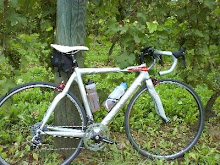
For the past 5 or 6 months I've been commuting mostly on a Glider Boxercross (one of the pre-production frames which I've customised a bit) running handbuilt wheels shod with Challenge Paris-Roubaix 28mm tubular tyres.
That's right, I've been commuting through London on tubs.
This has nothing to do with taking a stance in the clinchers vs. tubs debate; I'm not commuting on tubs because I think they're "better" but rather to prove that there's nothing especially difficult about mounting or changing them, or anything risky about riding with them, as many people seem to believe. So many people come into the shop looking for super light climbing wheels or deep, aero, carbon rims but suck air through their teeth and shake their heads when you mention a tubular option. And that's just the men! Female riders have been led to believe that riding with tubulars is something completely beyond them.
So I wanted to prove that not only are tubulars not as mysterious and difficult as people make them out to be, but that they are so easy to deal with that you can ride them every day and suffer no more incident, stress, or effort than riding clinchers.
This was always going to be a tricky thing to pull off; my commute into central London is along a bus lane and glass-littered gutters with so much traffic that you can't swerve to avoid the pot holes and debris. But I put my faith in what I knew to be the facts and just got on with it. In case of puncture, I ride with a canister of Vittoria Pitstop sealant and a frame-fit pump. (I love my Pocket Rocket, but with 28mm tyres I'd be pumping a long, long, time!)
One day, about three months ago, as I was riding along a section of road which had just been re-opened after having been coned-off for weeks to accommodate the reconstruction of a fire-razed building, I surveyed all the rubbish on the road and thought to myself, "They've really left this area a mess!" Then I heard the Pfffttttt of a punctured tyre and pulled over to evaluate the damage. My rear tyre had a large v-shaped cut in it, much too large to be sealed by the Pitstop. So, since I was wearing my MTB shoes, I walked the rest of the way (most of the way) and arrived at work a half-hour late.
After having replaced that front tub, I tried to be more wary of riding through glass and road debris and began inspecting my tyres for cuts more frequently.
One morning, I found a slit that was small, but so deep that it completely penetrated the casing and allowed a bit of the latex inner to bubble through. I knew that the sensible thing was to replace the tyre, but at £28 each (trade price) I decided to Blue Peter up a repair. I used a dab of super glue to seal the little split in the rubber, hoping it didn't contain a solvent that would eat away at the inner latex tube.
That night, I rode out to Crystal Palace to watch the Tuesday night racing before heading home - a 30-mile detour - and was very pleased that the repair held. But the next morning, the tyre was flat so I assumed it hadn't been a success after all.
When I finally got 'round to replacing the tyre a couple of days later, I discovered that the super glue repair had indeed done the trick and that this latest deflation was a bona fide puncture caused by a small shard of glass. It seemed the perfect opportunity to try out one of the puncture sealant options that we sell, so I squeezed in some Tufo extreme sealant and, hey presto!, the tub once more held air.
And all was well again until last weekend.
Our last customer in the shop on Saturday was an extremely enthusiastic new cyclist, and a clubmate, who managed to talk me into riding out to Richmond Park with her for a lap or two. The weather was great and we had Tony's company, too, since that's his route home. It was fun riding together through town, showing them my Thames-hugging route to the park.
Until we turned into Priory Lane and I realised that the softening sensation I'd dismissed as imagined was now undeniably a flat rear tyre.
I was able to ride - carefully - to the Roehampton Gate cafe, where we ran into Stephen (the shop mechanic) who'd been out for a few training laps. While Meagan queued for consolatory ice cream and coffee, Steve helped me find and seal the puncture.

Road Racing PitStop is recommended for use on road tyres up to 25mm. These Challenge tubs are 28mm, so I wasn't sure it would work. The pressurised canister contains a liquid latex - goo, I believe, is the technical term - that simultaneously inflates the tyre and delivers goo to the site of the puncture.

You can see goo oozing from the site of the puncture.

Steve's strong finger held it all together until the latex hardened sufficiently to create an effective seal. (My fingers were occupied with retaining the dribbles of some rapidly-melting pistachio ice cream.)
The PitStop repair held up under another week of commuting until I suffered a catastrophic puncture at Tower Hill one morning. I didn't have another shot of sealant with me, and wasn't prepared to ride alongside the Parade of Murderous Lorries that accompany my usual commute with a flat tub, so was once again reduced to walking in to work. At least my way was cheered by no less than three customers recognising me and calling Hi! from their own bikes as they passed.
Undaunted, I've since replaced that tub. I love the feel of them and at that width (24-28mm) there are a couple of robust and sexy options. I've just got some 27mm Vittoria Pave Evo CG's in reserve for when I have to replace the Challenge P-Rs. You might consider tubs esoteric and think my devotion to them eccentric, but I reckon this is the perfect winter commuting solution.
Wish me luck!